Unesco

At the 18th session of UNESCO’s Intergovernmental Committee for the Safeguarding of the Intangible Cultural Heritage, held from 5 to 9 December 2023 in Kasane, Botswana, Midwifery: Knowledge, Skills and Practices was inscribed on 6 December 2023 on UNESCO’s Representative List of the Intangible Cultural Heritage of Humanity, upon the recommendation of UNESCO’s Evaluation Body.
The Republic of Slovenia also participated in the preparation of the nomination file. This was a multinational nomination prepared jointly by Colombia, Cyprus, the Kyrgyz Republic, Luxembourg, Nigeria, Togo and Germany, with Germany coordinating the nomination process. The proposal for the inscription of midwifery in the national Register of the Intangible Cultural Heritage was prepared by the Slovene Ethnographic Museum, acting as the Coordinator for the Safeguarding of the Intangible Cultural Heritage, based on an initiative prepared by the National Institute of Public Health, represented by Dr Zalka Drglin. The Ministry of Culture inscribed the element into the Register on 14 December 2021.
Midwifery encompasses specialized knowledge and skills related to childbirth assistance for women and newborns. It includes support and interventions during pregnancy, childbirth and the postpartum period, as well as breastfeeding and newborn care. The aim is a safe delivery and a high-quality beginning of family life.
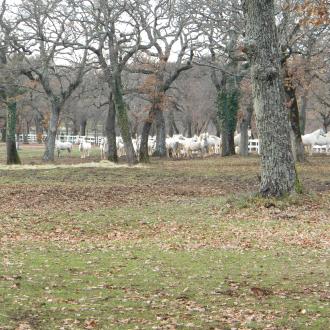
UNESCO’s Intergovernmental Committee for the Safeguarding of the Intangible Cultural Heritage, which met in Rabat, Morocco, from 28 November to 3 December 2022, inscribed the multinational nomination Lipizzan Horse Breeding Traditions on UNESCO’s Representative List of the Intangible Cultural Heritage of Humanity. Slovenia submitted the nomination file to UNESCO headquarters in March 2020 on behalf of the eight participating countries. The nomination was highlighted by UNESCO’s Evaluation Body as an example of good practice in its preparation.
On 1 December 2022, the Intergovernmental Committee inscribed the multinational nomination Lipizzan Horse Breeding Traditions on UNESCO’s Representative List of the Intangible Cultural Heritage of Humanity. Eight countries participated in preparing the multinational nomination, which was coordinated by the Republic of Slovenia: Austria, Bosnia and Herzegovina, Croatia, Hungary, Italy, Romania, Slovakia and Slovenia. The nomination was prepared between 2018 and 2020, during which working meetings were held in the participating countries, bringing together bearers of the element of intangible cultural heritage, experts, and representatives of state institutions responsible for safeguarding intangible cultural heritage. The project was led by the Ministry of Culture of the Republic of Slovenia, represented by Špela Spanžel. Representing Slovenia in the international working group—composed of representatives of all participating countries—were also a representative of the Lipica Stud Farm and representatives of the Slovene Ethnographic Museum / Coordinator for the Safeguarding of Intangible Cultural Heritage. Together with the Ministry of Culture and the bearers, they ensured that the element Traditional Breeding and Rearing of Lipizzan Horses was inscribed into the national Register of the Intangible Cultural Heritage in 2016, which is a prerequisite for submitting a UNESCO nomination. The professional content of the multinational nomination was prepared with the participation of M.A. Anja Jerin, curator for intangible cultural heritage, and Dr Nena Židov, curator for social culture. The preparation of the nomination film was coordinated by Nadja Valentinčič Furlan, curator for ethnographic film.
The multinational nomination presents the richness of the tradition of Lipizzan horse breeding in state stud farms and among private breeders in all participating countries. It encompasses several domains of intangible cultural heritage as defined by UNESCO’s 2003 Convention for the Safeguarding of the Intangible Cultural Heritage. At the heart of the nomination Lipizzan Horse Breeding Traditions are cultural and social practices, knowledge and skills, as well as oral traditions related to the breeding of Lipizzan horses. Their symbolic significance within individual communities and their integration into local environments are based on the reciprocal relationship between the bearers of this intangible cultural heritage and the Lipizzan horses.
Traditional breeding and rearing of Lipizzan horses includes the breeding of the Lipizzan horse for classical dressage riding and carriage driving. In Slovenia, Lipizzan horses are bred and raised at the Lipica Stud Farm and by private breeders.
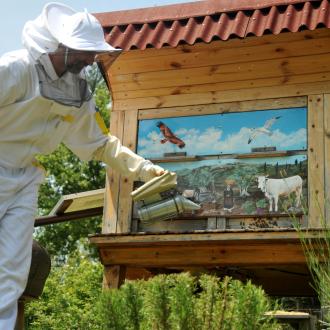
UNESCO’s Intergovernmental Committee for the Safeguarding of the Intangible Cultural Heritage, which met in Rabat, Morocco, from 28 November to 3 December 2022, inscribed the nomination Beekeeping in Slovenia, a Way of Life, submitted by Slovenia in March 2021, on UNESCO’s Representative List of the Intangible Cultural Heritage of Humanity. The nomination was highlighted by UNESCO’s Evaluation Body as an example of good practice in its preparation.
On 1 December 2022, at its 17th session, the Intergovernmental Committee endorsed the recommendation of UNESCO’s Evaluation Body that the nomination Beekeeping in Slovenia, a Way of Life be inscribed on UNESCO’s Representative List.
In 2015, an initiative to inscribe beekeeping in the national Register of the Intangible Cultural Heritage was submitted to the Slovene Ethnographic Museum, which performs the tasks of the Coordinator for the Safeguarding of the Intangible Cultural Heritage. In cooperation with the bearers and with the support of the Slovenian Beekeepers’ Association, the Coordinator prepared several proposals related to this field, which were inscribed into the Register between 2018 and 2020. The elements of intangible cultural heritage inscribed into the Register are: Beekeeping; Painting of Beehive Panels; Migratory Beekeeping; Making of Beehives and Apiaries; Breeding of Carniolan Queen Bees; and Apitherapy. The elements Gingerbread Making and the Making of Small Breads and Wooden Models are also indirectly related to the proposed element.
In December 2018, the Slovenian Beekeepers’ Association established a working group to prepare the nomination for the inscription of beekeeping in Slovenia on UNESCO’s Representative List. The project of preparing and submitting the nomination was led by the Ministry of Culture, represented by Špela Spanžel. The working group that prepared the nomination and the necessary documentation included representatives of the bearers, the Slovenian Beekeepers’ Association, the Beekeeping Museum in Radovljica, and the Slovene Ethnographic Museum / Coordinator for the Safeguarding of Intangible Cultural Heritage, represented by M.A. Anja Jerin, curator for intangible cultural heritage; M.A. Adela Pukl, curator for spiritual culture; and Barbara Sosič, curator for economic practices, transport and traffic culture.
The nomination presents beekeeping in Slovenia, with an emphasis on its cultural significance. The bearers are beekeepers organised in more than 200 associations united within the Slovenian Beekeepers’ Association. In terms of the number of beekeepers per 1,000 inhabitants, Slovenia ranks among the highest in the world and is also recognised for its expertise and advanced beekeeping technologies. Beekeepers pass on their skills, knowledge and values from generation to generation, which is reflected in their exceptionally positive impact on the wider community and the environment. Distinctive features of beekeeping in Slovenia include the indigenous Carniolan honey bee, apiaries, painted beehive panels, and AŽ hives.
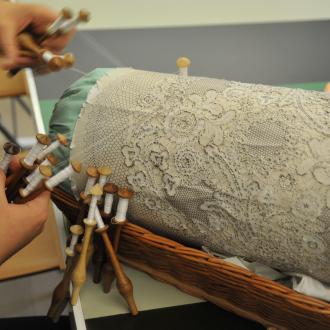
At its 13th session, held in Port Louis, Mauritius, UNESCO’s Intergovernmental Committee for the Safeguarding of the Intangible Cultural Heritage inscribed the nomination Lace-making in Slovenia on UNESCO’s Representative List of the Intangible Cultural Heritage of Humanity on Thursday, 29 November 2018.
The nomination brought together the bearers of two elements from across Slovenia that are inscribed in the national Register of the Intangible Cultural Heritage under the elements Idrija Lacemaking and Slovenian Lacemaking.
Lacemaking is the craft of producing lace by interweaving threads wound on bobbins. In the Idrija region, it has been present since the second half of the 17th century. In the 19th century, it spread from Idrija and became established in a wider area, where it developed new forms of expression.
Bobbin lacemaking is the handcraft of producing lace by crossing, twisting and interweaving threads wound on bobbins. The term Slovenian lace became established in the period between the two World Wars in the territory of present-day Slovenia, which at that time formed part of the Kingdom of Yugoslavia.
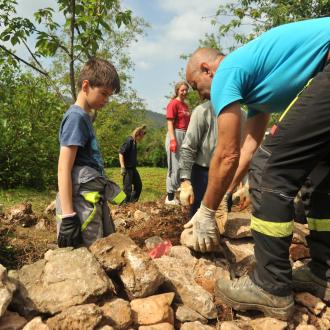
At its 13th session, held in Port Louis, Mauritius, on Wednesday, 28 November 2018, UNESCO’s Intergovernmental Committee for the Safeguarding of the Intangible Cultural Heritage inscribed the multinational nomination Art of Dry Stone Walling: Knowledge and Techniques on UNESCO’s Representative List of the Intangible Cultural Heritage of Humanity. The Slovene Ethnographic Museum, acting as the Coordinator for the Safeguarding of the Intangible Cultural Heritage (Anja Jerin, Nena Židov), also participated in the preparation of the nomination file.
At the 19th session of UNESCO’s Intergovernmental Committee for the Safeguarding of the Intangible Cultural Heritage, held from 2 to 7 December 2024 in Asunción, Paraguay, the extension of the already inscribed element Art of Dry Stone Walling: Knowledge and Techniques, originally inscribed on the Representative List in 2018, was also approved. Eight countries initially participated in the nomination (Croatia, Cyprus, France, Greece, Italy, Slovenia, Spain and Switzerland). At the 2024 session, Andorra, Austria, Belgium, Ireland and Luxembourg joined the multinational nomination.
Dry stone walling is the craft of building without the use of mortar. By selecting and arranging locally available stone—obtained through clearing and preparing land—and with an understanding of structural principles, various types of durable stone structures are created.
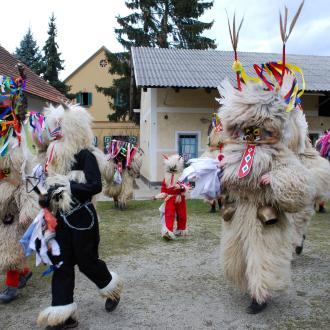
At its session held on Jeju Island, Republic of Korea, on Thursday, 7 December 2017, UNESCO’s Intergovernmental Committee for the Safeguarding of the Intangible Cultural Heritage inscribed the second Slovenian nomination, Door-to-door Rounds of Kurenti, on UNESCO’s Representative List of the Intangible Cultural Heritage of Humanity.
Slovenia ratified UNESCO’s Convention for the Safeguarding of the Intangible Cultural Heritage in 2008, when the national Register of Intangible Cultural Heritage of Slovenia also began to be established. The element Door-to-door Rounds of Kurenti was entered into the Register in 2012 as its sixth element and was proclaimed intangible cultural heritage of national importance in 2015. In 2016, the Republic of Slovenia submitted the nomination Door-to-door Rounds of Kurenti for inscription on UNESCO’s Representative List. The Evaluation Body of UNESCO’s Intergovernmental Committee recognised the nomination as exemplary in its preparation.
The nomination was prepared with the participation of representatives of the bearers (associations and the Federation of Kurent Associations), the Scientific Research Centre Bistra Ptuj, the Ptuj-Ormož Regional Museum, the Slovene Ethnographic Museum as the Coordinator for the Safeguarding of the Intangible Cultural Heritage of Slovenia, and the Ministry of Culture.
The Door-to-door Rounds of Kurenti are a Shrovetide custom practised in the regions of Ptuj and the Drava Plain, as well as in Haloze and the Slovenske Gorice hills. The Kurent is the most widespread traditional Shrovetide figure and, according to folk belief, drives away evil and brings happiness and prosperity.
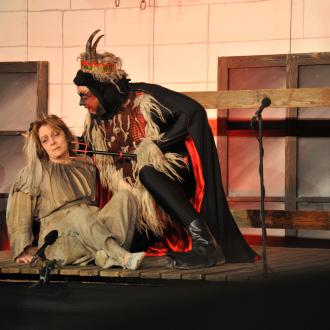
At its session held in Addis Ababa, Ethiopia, on Thursday, 1 December 2016, UNESCO’s Intergovernmental Committee for the Safeguarding of the Intangible Cultural Heritage inscribed the Škofja Loka Passion Play on UNESCO’s Representative List of the Intangible Cultural Heritage of Humanity. The play, based on the 1721 text by Father Romuald Marušič, is performed in Škofja Loka during the Easter season.
Slovenia ratified UNESCO’s Convention for the Safeguarding of the Intangible Cultural Heritage in 2008, when the national Register of Intangible Cultural Heritage of Slovenia also began to be established. The Škofja Loka Passion Play was the first element to be entered into the Register in 2008 and was proclaimed intangible cultural heritage of special national importance in 2012. In 2015, the Republic of Slovenia submitted the nomination for its inscription on UNESCO’s Representative List of the Intangible Cultural Heritage of Humanity. In 2016, the Evaluation Body of UNESCO’s Intergovernmental Committee recognised the nomination as suitable and recommended its inscription. The Škofja Loka Passion Play thus became the first element of Slovenia’s intangible cultural heritage to be inscribed on UNESCO’s Representative List.
The nomination was prepared with the participation of representatives of Škofja Loka, the Slovene Ethnographic Museum as the Coordinator for the Safeguarding of Intangible Cultural Heritage of Slovenia, and the Ministry of Culture.
The Škofja Loka Passion Play is a penitential Passion procession based on the 1721 text by Father Romuald Marušič, depicting Christ’s suffering. During the Easter season, it is performed in Škofja Loka by local volunteer amateur actors.